
Trenchless mainline
The received picture of trenchless is a long bore under a river, with a trench either side of it. This is the other thing: building the entire line as a chain of back-to-back drilled segments, so the ground between the tie-in points is never opened at all.
Why it is a different engineering problem
A crossing is a one-off. You engineer it, you resource it, you accept a high cost per metre because the alternative is impossible, and then you go back to trenching. A trenchless mainline is a production process: a hundred and fifty segments in a row, each one of which has to be quick, repeatable and cheap enough that the method competes with a trencher on open ground.
Almost everything that makes a crossing succeed — the long profile, the heavy rig, the large over-ream, the elaborate fluid programme — makes a mainline uneconomic. The skills do not transfer automatically, and most of the received wisdom about HDD quietly assumes a crossing.
- One long bore under a named obstacle
- Deep arc, driven by the feature being crossed
- Large over-ream, multiple passes, heavy fluid programme
- Heavy rig class, long set-up, days per bore
- High cost per metre, accepted because there is no alternative
- Trenched approach on both sides
- Many short segments end to end, the whole alignment
- Shallow profile that conforms to grade rather than flying an arc
- Compaction reaming: the soil is displaced, not excavated and washed out
- Mid-class rigs, fast set-up, repeatable shifts
- Cost per metre that competes with open cut
- Excavation only at the tie-in points
Compaction reaming
The core move. Rather than cutting a hole and washing the spoil out with high-pressure, high-volume fluid, the reamer displaces and compacts the soil into the bore wall. In displaceable ground — silts, clays, clay till — that gives a stable hole with far less fluid, far less pressure, and no spoil to manage. Less pressure is also the whole frac-out story: the mechanism that pushes drilling fluid to surface is largely absent because the pressure that drives it is never generated.
It does not work everywhere. Where cobble and gravel are the primary soil, there is nothing to compact and the method is the wrong one. Knowing which ground is which, from a geotechnical report rather than after mobilisation, is most of the value.
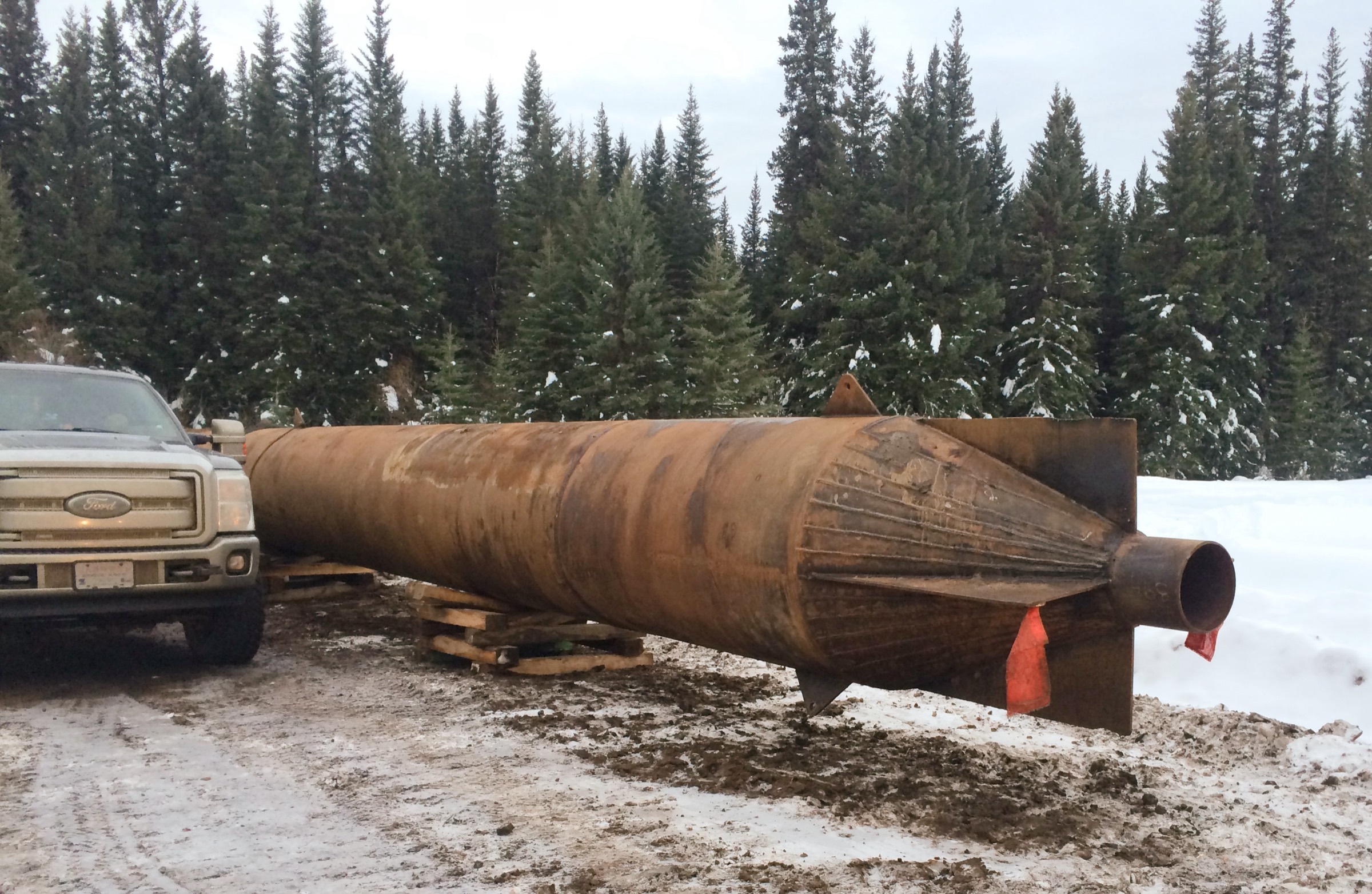
A compaction reamer does not cut a hole. It makes one.
The steel above is the whole difference between a crossing and a mainline. It displaces the soil outward into the bore wall instead of cutting it loose and washing it out — so there is no spoil to manage, far less fluid to pump, and far less pressure to contain.
Which is also why the frac-out risk largely goes away: the mechanism that drives drilling fluid to surface is pressure, and this method never generates much.
The design rules that are specific to it
- Conform to grade, do not fly an arc. A mainline segment follows the surface profile at a constant cover. The arc geometry that governs a crossing does not apply, and applying it produces needlessly deep, needlessly expensive bores.
- One pipe per pull. Bundled installations twist, pulse against each other and interact thermally. Each line is installed on its own, even where three share the corridor.
- Line assignment. In a multi-line corridor each line gets an assigned lane, set in from the disposition boundary, with room reserved for the lines that are not built yet.
- Anti-collision, continuously. On a brownfield re-entry corridor the pullback path is monitored against the pilot as-built in real time, with a radial tolerance beyond which the pull stops.
- Segment length is an economic variable. Long segments mean fewer tie-ins but higher risk per bore. The optimum is a calculation, not a preference.
What the footprint does
This is the argument that usually wins the permit. A conventional pipeline right of way is twenty-five to thirty metres of cleared, grubbed and reinstated ground. A trenchless mainline works inside:
On a recent northeast British Columbia system, designing the line this way took the construction strategy to roughly a quarter of the permitted disturbance footprint — about 44 of 59 permitted hectares planned to be handed back untouched. On ground carrying old-growth, riparian reserve, wildlife tree patches or archaeological sites, that is often the difference between a permit and a refusal.
The scale this has been designed at
A 2024–25 northeast British Columbia interconnect: about 65 km of NPS 6 to NPS 12 sour-service steel across nine segments, eight of them re-entry within an existing corridor. The execution design carried 149 trenchless segments totalling 31,267 m — roughly 80 per cent of the alignment — with 13 engineered HDD crossings and the remainder open-cut deflections. Average trenchless segment 420 m, longest just over 1,000 m.
Those are the design and tender figures. The project was stopped by the client partway through construction for reasons unrelated to the trenchless method, so they are not a claim about completed metres — they are what the method was engineered to do at that scale, which is the part we are selling.
Where this came from
Extending the practical length of a single compaction-reamed pull — from the two-to-four-hundred-metre class that was normal, out past a kilometre — was the subject of a formal experimental development programme recognised under the federal scientific research and experimental development scheme. The tooling that came out of it, including the vibratory hole packer, is part of what makes the long segments possible.
Proprietary, field-proven and recognised for research purposes. Not patented, and we do not say otherwise.