
Ground
Every trenchless failure is, eventually, a ground failure — either the ground was not what the design assumed, or the design never asked.
What each kind of ground does
Silts, clays and clay till
Displaceable, stands well, compacts into the bore wall. This is what compaction reaming is for and where long segments are achievable. Clay balls up on tooling, which is a fluid-chemistry problem, not a showstopper.
Competent rock
Holds a hole beautifully. Needs a mud motor or a down-hole hammer, a different fluid programme and much slower progress. Predictable, and expensive.
Cobble and boulder
The genuine defeat condition. Nothing to displace, nothing to hold a hole, tooling deflects off clasts and steering goes. Where cobble or gravel is the primary soil, the answer is usually a different method or a different alignment.
Running sand
Will not stand without support, so the hole closes behind the tooling. Bentonite earns its place here. Below the water table it is a serious constraint.
Organics, peat and muskeg
Low confinement means a much lower pressure ceiling — the envelope derates, the fluid programme gets conservative, and inadvertent returns are far more likely.
Mixed face and contacts
The till-to-bedrock contact is where steering is lost and assemblies are damaged. A profile that runs along a contact rather than crossing it cleanly is a design error.
For reference, the ground the long-segment trenchless work on record was developed in: stratified glaciolacustrine silts and high-plastic clay over clay till, with sandstone and shale cobbles and boulders through it. Displaceable, with enough hard content to be interesting.
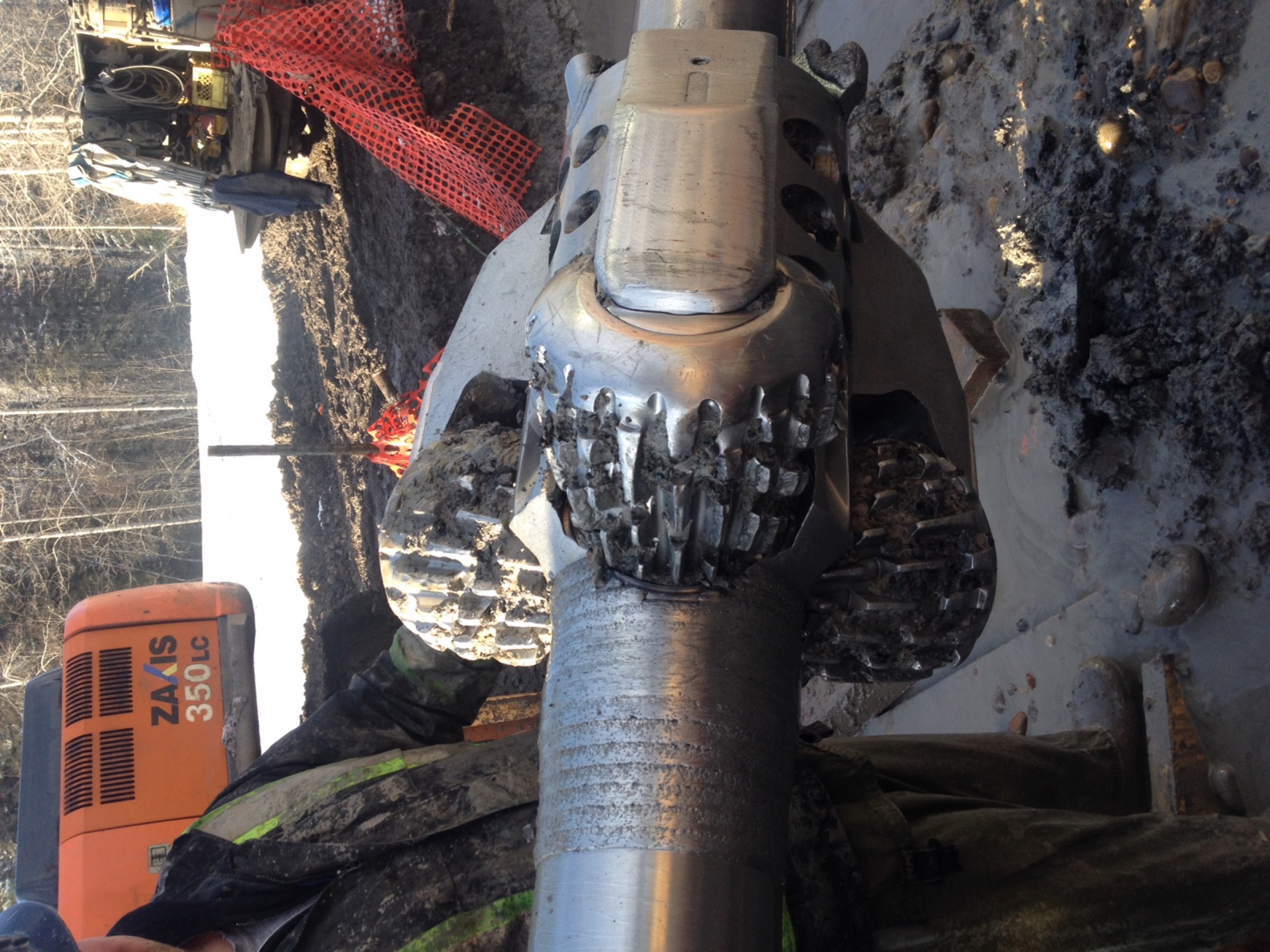
The bit tells you what the report did not.
Jetting assemblies in tills and clays. A mud motor and a rock bit like this one where the formation will not displace. The ground chooses, and it is not a preference.
Which is why an investigation that characterises the banks and not the profile has not characterised the bore. The expensive discovery is the one made by the tooling.
What the investigation actually has to cover
- Along the profile, not at the abutments. Two holes at the banks of a river tell you almost nothing about the middle third, which is the part you are drilling.
- At bore depth and below it. An investigation terminated above the design depth has not characterised the bore.
- Cobble and boulder content, honestly. Standard sampling under-represents coarse fractions. The driller's log and the recovery record usually say more than the summary table.
- Groundwater. Levels, artesian conditions, and permeable layers that give fluid somewhere to go.
- Strength and plasticity. What tells you whether the ground will stand, compact, or flow.
- The contacts. Where the material changes, and at what depth, along the whole alignment.
It usually is. The useful response is not to refuse to design, and not to design as though the data were complete — it is to say precisely which assumption is carrying the risk, what one more borehole in one named place would resolve, and what it costs to be wrong. A supplementary hole is almost always cheaper than the contingency it retires.