
HDD crossings
A single engineered bore under something you cannot open: a river, a highway, a rail line, a wetland, an archaeological site, or a corridor with a hundred other pipelines already in it.
What governs the design
The feature decides it
At a watercourse, scour depth and the regulator's minimum below the thalweg. At a highway or rail, the authority's own setback. Under a facility, the separation calculation. Depth then sets the profile, and the profile sets everything else.
And what it does to the pull
Load accumulates with contact length and with every bend. Doubling the length considerably more than doubles the pull, which is why long crossings are governed by the pipe, not the rig.
Method follows geology
Jetting assemblies in tills and clays. Mud motors and down-hole hammers in rock. The transition zone between them is where most crossings get into trouble.
Both ends, on the ground you have
Rig side needs a working pad and the entry angle. Pipe side needs a continuous string the full length, or a plan to weld through the pull. Many crossings are actually constrained by the pipe-side layout.
The shallow ends
The pressure envelope is tightest where cover is least, which is at the entry and exit. That is where inadvertent returns happen, not in the middle under the river.
What else is down there
In a congested corridor the binding constraint is holding separation from every foreign facility along the whole path — not the crossing itself.
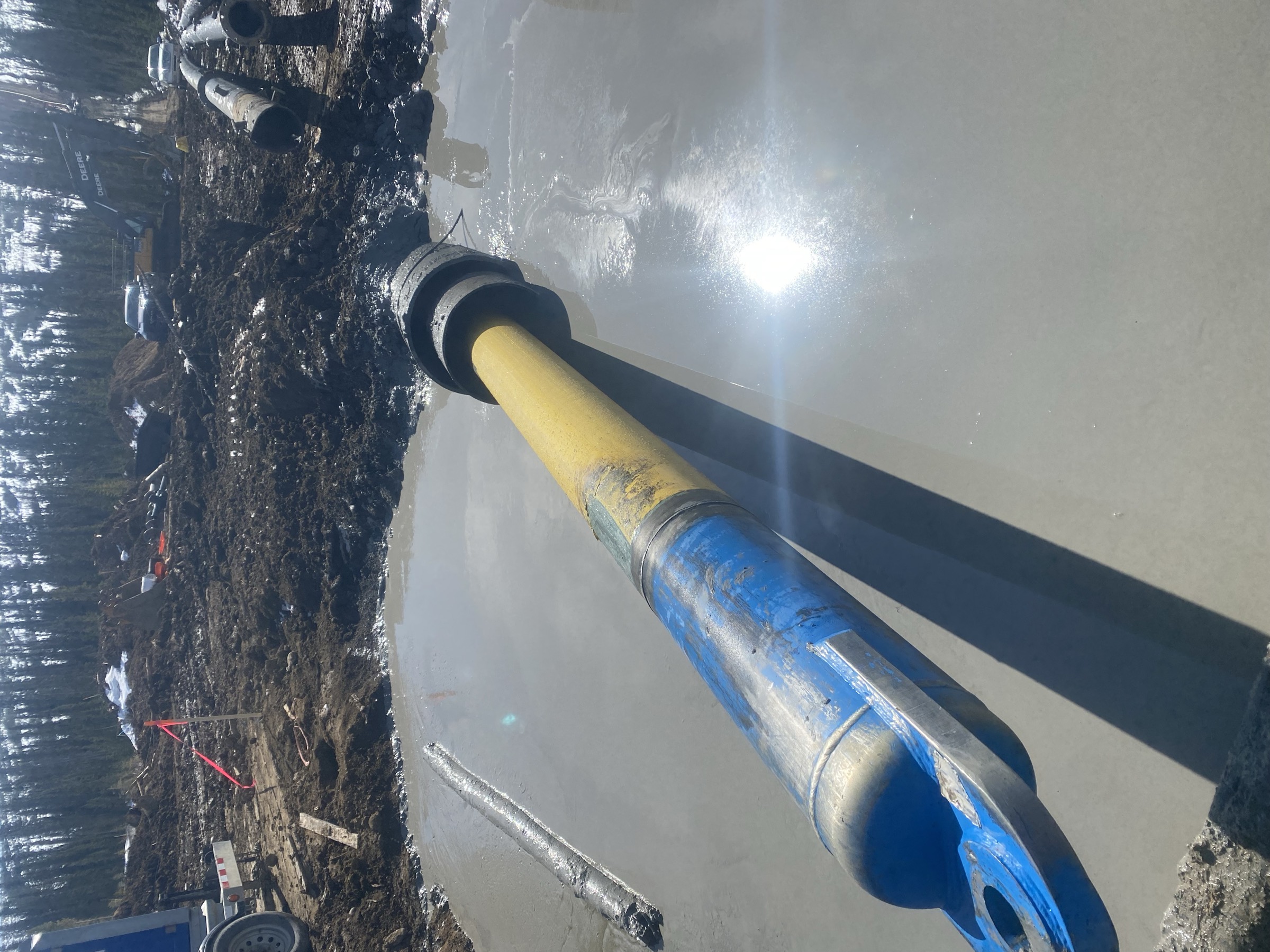
The crossing is rarely the hard part. Getting to both ends of it is.
A profile that works on paper still needs a rig pad, a pull-string layout the full length of the bore, access for the spread, and somewhere to put containment — on ground you control, in a season you are permitted to work in.
More crossings are redesigned for surface reasons than for subsurface ones.
Intersect bores
On very long or difficult crossings, two rigs drill toward each other from opposite banks and the pilot holes are intersected mid-bore. It doubles the spread cost and demands far better navigation, and it is often the only way to get a long crossing done at acceptable risk — the reach from either side is halved, and so is the accumulated error.
Several of the longest installations on this practice's record were intersects, including crossings past three kilometres. It is a technique with a narrow band of correct application: proposed too early it wastes money, proposed too late it is the rescue plan for a bore that is already in trouble.
Where crossings are actually lost
- On the pullback, to pull force. The load was computed on the total length instead of segment by segment, and the real governing case was somewhere else.
- To hole collapse. The formation would not stand, the ream schedule assumed it would, and the hole closed on the string.
- To an inadvertent return. The pressure envelope was never computed, so there was no number to monitor against and no trigger to act on.
- To the ground being different. The investigation characterised the banks and not the profile, and the cobble layer was found by the bit.
- To navigation. Walkover coverage was lost where it was always going to be lost — under deep water, under a highway, in interference — with no wireline fallback planned.
- To a strike. The separation was asserted rather than computed and monitored.
Every one of those is a paper failure before it is a field failure. That is the whole argument for having somebody read the design who has seen it happen.