
Four companies, one continuous body of work.
Technical HDD did not appear fully formed. The method, the tooling and the judgement were built across four operating companies over about three decades — each one solving the problem the last one had run into. This is that sequence, because the engineering only makes sense read in order.
The trade — from 1992
Pipeline construction from the ground up, through three western Canadian contractors, before any of it was ours. Everything downstream is built on having done the work rather than having read about it.
Down Under Drilling — to 2014
The first company of our own, and where trenchless stopped being a crossing technique. Water, wastewater and oil-emulsion gathering installed by drill rather than trench: a national park's water and wastewater mains, a seventy-two kilometre emulsion gathering system, municipal transmission mains. Around 172 km of it documented project by project, with the rest of a much larger claimed total left where it was published rather than restated here.
Atlas Energy Services — 2010 to 2013
The conventional-construction arm, formed so the group could bid work the trenchless brand was typecast out of. Forty-one recorded programmes in three years for a dozen producers and midstreamers — gathering systems, trunk lines, compressor stations, tank farms, pig-launching skids. It also ran a registered pressure-piping quality programme, which is where the documentation discipline came from.
The Technical Group — 2013 to 2018
The operating peak, and the record this practice is named for: 2,108.8 km across 5,722 bores, thirteen rigs in five classes from twenty to three hundred and seventy-five tonnes, five bases, and an average bore length that more than doubled over the period. The trenchless mainline method reached its mature form here.
Directional drilling — 2020 to 2024
A smaller, seven-rig operation working river crossings and gathering programmes in Alberta and northeast British Columbia — Waskahigan, Cutbank, Wapiti, Conklin. Engineered crossings with intersect planning, third-party fluid programmes and steering subcontractors: the modern shape of the work, and the era closest to what clients are building today.
Technical HDD — now
The rigs are gone. What is left is the part that took thirty years and cannot be bought: the design basis, the failure modes, the tooling knowledge and the judgement about ground. That is the consultancy. What we are retained for →
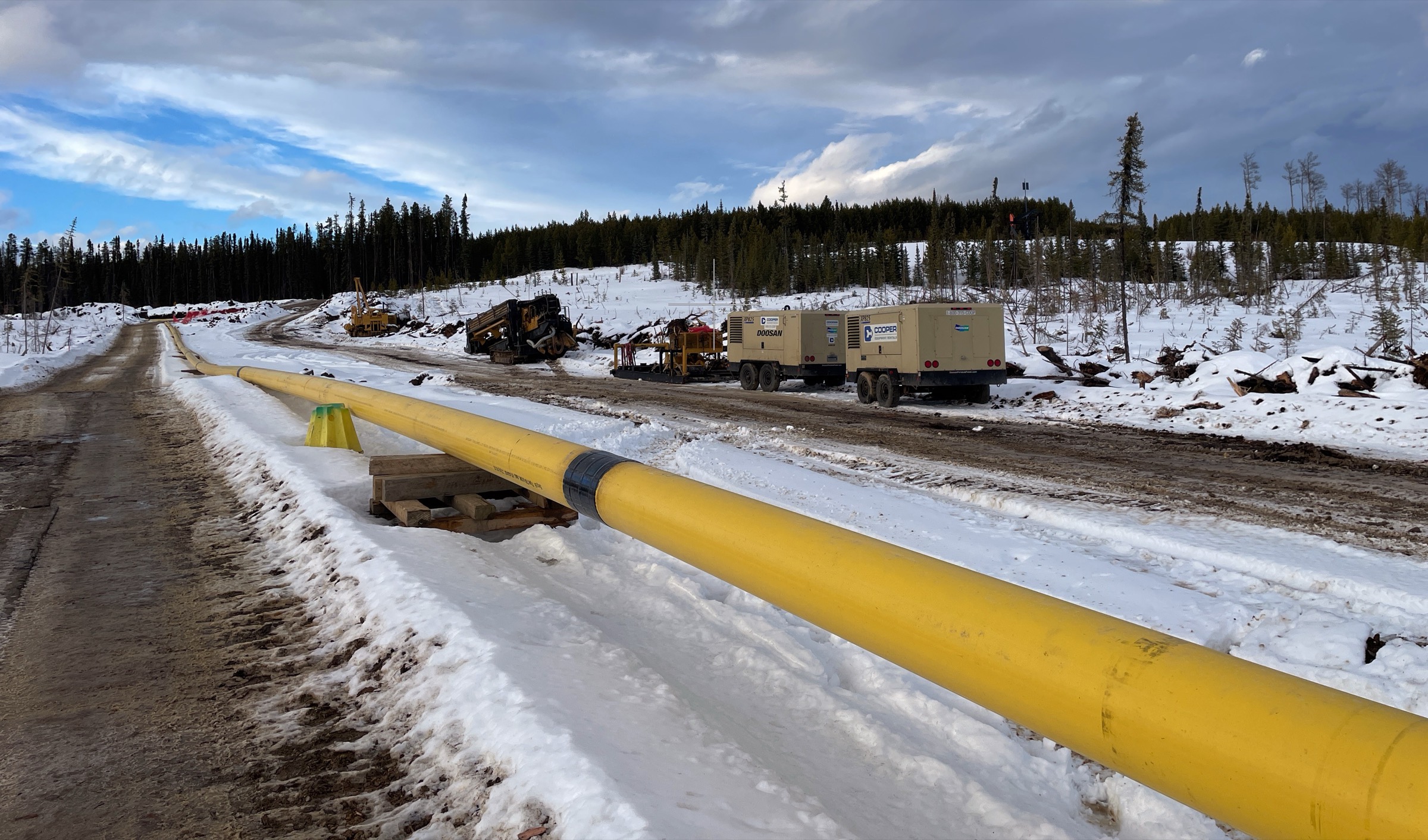
None of it was learned on a whiteboard.
Every design rule on this site started as something that went wrong on a lease, in front of a crew, with a client waiting.
That is the whole argument for retaining a practice built out of a contractor rather than around one.
How a single pull got from four hundred metres to past a kilometre.
The most useful thing in this history is not a project. It is a three-year development programme, run 2010 to 2013 under the federal scientific research and experimental development scheme, that set out to extend the distance a single pipe could be pulled through a compaction-reamed bore.
It is worth telling properly, because every failure in it is a failure a client can still have today.
The problem that started it
Pulling composite pipe beyond the accepted two-to-four-hundred-metre limit damaged it — and the damage showed up in routine pressure testing afterwards, not during the pull. That is the worst way to find anything.
A packer behind the reamer
A down-hole packer was built to follow the reamer and give the ground longer to compact. The first prototypes were too long, generated too much friction and broke down-hole. Shortened, they worked.
The pressure nobody had accounted for
Fluid pressure built up ahead of the assembly and escaped to surface, spiking friction. The reamer and packer combination was redesigned to let fluid move at lower pressure — the same principle the whole low-pressure method rests on.
Vibration
The theory was that vibrating the string would cut friction. A battery-driven motor with an eccentric counterweight was cut into a packer body and welded shut. The first liquid-cell batteries failed under their own vibration; solid-core cells survived. A single battery carried about seven hundred metres before going flat, so two were run in series — which introduced arcing between cells, and another redesign.
The pipe fighting back
Polyethylene stretches under tension and then retracts, and it was transmitting that load back up the string as it settled — worst where lubrication was thin. A tension-spring shock absorber was built into the connection between pipe and string to absorb it.
And the rig fighting back
Fluid and moisture down-hole caused hydro-locking, throwing reverse thrust into the rig. First a swivel on the rig vice, then a sprung mechanism to absorb push and pull torque. Running the pipe along the bottom of an oversized hole rather than centred in it turned out to reduce both the locking and the debris damage.
Every one of those six is a live failure mode. If somebody proposes a thousand-metre pull, these are the questions: what is the pull-force margin at the governing segment, what happens to annular pressure ahead of the assembly, how is the load transient at settlement absorbed, and what happens to the rig if the hole hydro-locks. We ask them because we have been on the wrong end of all four.
Proprietary and field-proven. Recognised as experimental development for federal research purposes. Not patented — no patent and no trade mark was ever filed for any of it, and we would rather say so than let a brochure claim stand.
Trenchless was doing municipal water before it was doing gathering systems.
The earliest company installed potable water, wastewater and oil-emulsion gathering by drill across national park land, county road allowances and municipal transmission corridors — ground where open-cut was either refused outright or ruinously expensive to reinstate.
That era also carried the full trenchless toolkit rather than just HDD: pneumatic percussion air drilling with no drilling mud at all, pipe ramming, pipe bursting, slip lining, and isolated open-cut watercourse crossings using turbidity curtains, water dams and flumes. A consultancy that only knows directional drilling will recommend directional drilling. Choosing a method →
Several of these were public bodies and they were named in the company's own published profile at the time. We still do not list them, for the same reason we do not list anyone else's — see how we work. If you want the named record for a prequalification, ask and we will provide it directly.