
Rig classes
Thirteen numbered rigs in five classes, each fielded as a complete package — machine, navigation, fluid and solids control, tooling and support. Two of the five classes were machines built in the group's own shop rather than bought.
| Class | Rigs | Machine | Push / pull | Rotary torque | Drill pipe |
|---|---|---|---|---|---|
| 20-ton | 10 · 11 | Vermeer D36x50 | 36,000 lb | 5,000 ft-lb | 2.625″ |
| 50-ton | 20 · 21 · 22 | Vermeer D100x120 Series II | 100,000 lb | 12,000 ft-lb | 20′ × 3.5″ |
| 100-ton | 30 · 31 · 32 | Tech HD 200x250 — built in house | 200,000 lb | 25,000 ft-lb | 20′ × 3.5″ |
| 175-ton | 40 · 41 · 42 | Tech HD 330x500 — built in house | 330,000 lb | 50,000 ft-lb | 5″ G105 |
| 375-ton | 50 · 51 | Vermeer D750x900 | 750,000 lb | 90,000 ft-lb | 5.5″ G105 |
What went with each machine
A rig is not a spread. Each class was fielded with a navigation package, a fluid and solids-control train sized to the hole volume, a tooling set matched to the formations it would see, and the support fleet that keeps all of it turning — water trucks, tool-crib trailers, crew trucks and environmental response units.
- Navigation. Walkover guidance with satellite positioning across all classes, with a logging tool and an annular pressure transmitter; wireline steering added from the 50-ton class up.
- Fluids and solids. Desanding and desilting to a fine cut with linear shakers through the mid fleet; dual scalping shakers and high-capacity centrifuges on the 175- and 375-ton spreads.
- Tooling. Jetting assemblies for tills and clays, motors and down-hole hammers for rock, and reamer sets from 8 to 60 inches depending on class.
- Fleet management. Real-time positioning on all in-field equipment.
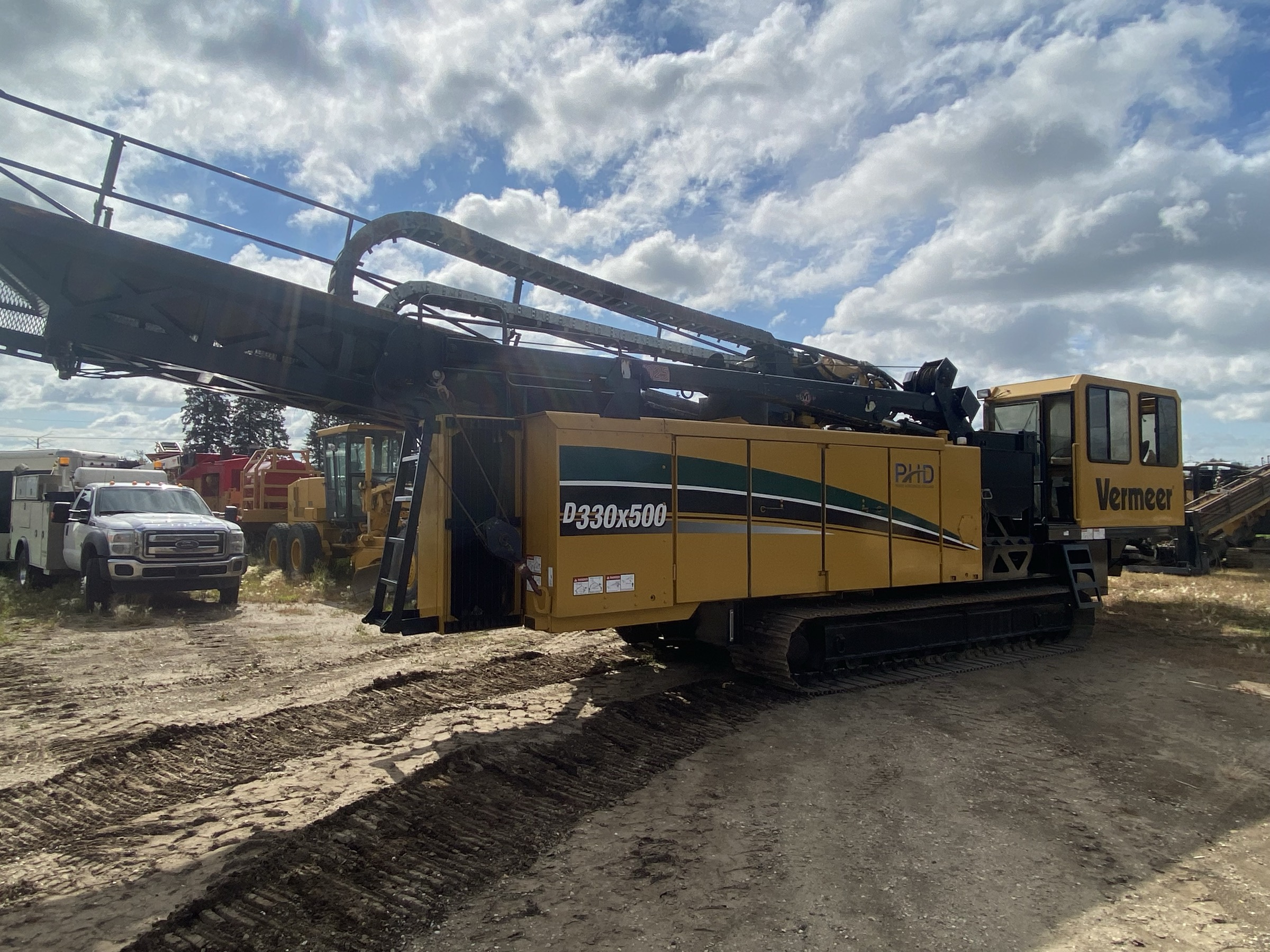
Three hundred and thirty thousand pounds of pull, and the pipe will take two hundred.
This is the mismatch at the centre of most lost pullbacks. The rig's rating and the product's allowable are different numbers, and the rig's is almost always the bigger one.
Somebody has to own the limit that actually matters, write it on the drill plan, and tell the driller what it is.
Site footprint by class
The thing most often underestimated at planning stage. The spread has to fit on ground you control, at both ends.
Because the commonest equipment error we see is a class mismatch — a rig too small for the computed pull, or a maxi rig mobilised for a job a mid-class machine would do faster and cheaper. Knowing what each class actually needs around it, and what footprint it lands on, is the difference between a spread that works and one that is waiting on water trucks.