
Seven installations, in full.
These are the seven case studies this practice published of its own trenchless mainline work. They were anonymised when they were written and they stay that way here. What they carry is the part that is actually useful to somebody planning a line: how long, through what, how many lines in one corridor, how wide the working width had to be, and how many days it took.
| Case | Product | Installed | Crossings | Lines in corridor | Ground | Working width | On site |
|---|---|---|---|---|---|---|---|
| One | NPS 8 yellow-jacket steel | 5,884 m | 7 | 1 | Clay | 5 m | 9 days |
| Two | NPS 4 steel with HDPE liner | 3,688 m | 8 | 1 | Clay | 5 m | 4 days |
| Three | NPS 3 composite and NPS 6 steel | 10,138 m | 14 | 5 | Clay, cobble, muskeg | 2–8 m | 14 days |
| Four | NPS 3 composite | 4,278 m | 8 | 4 | Clay, gravel, sand, muskeg | 5 m | 4 days |
| Five | NPS 3 composite and NPS 6 steel | 4,228 m | 8 | 3 | Clay | 5 m | 7 days |
| Six | NPS 3 composite | 15,742 m | 26 | 7 | Clay, cobble, muskeg | 2–7 m | 7 days |
| Seven | NPS 4 composite steel | 3,278 m | 6 | 1 | Sand, gravel, cobble, sandstone | 5 m | 17 days |
Each case was verified against an instrumented pull-force and downhole-pressure trace taken during the installation — the savings and the production figures were never estimates.
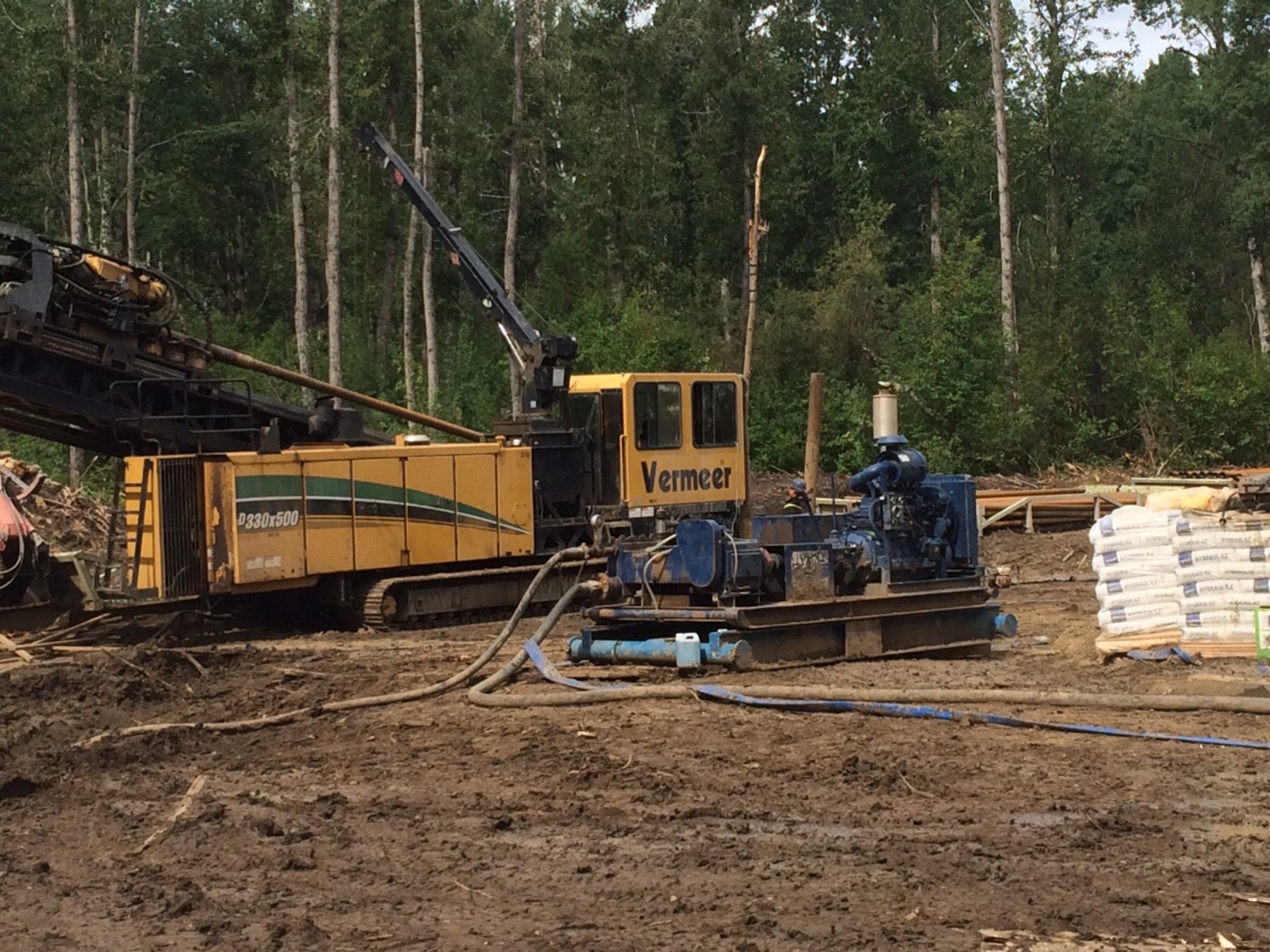
Two rigs on one corridor, and five more lines to come.
Multi-line re-entry is where trenchless mainline gets genuinely difficult: every new bore has to hold separation from every line already in the ground, along its whole length, with no room to move sideways.
It is also where it pays for itself, because the corridor was only cleared once.
What to read out of them
Seven lines in one corridor
15,742 m installed through twenty-six crossings with seven separate lines sharing a two-to-seven-metre working width. Each line in its own hole, one metre apart. That is the multi-line re-entry problem solved in the field rather than on a drawing, and it is the hardest thing on this page.
Ten kilometres through mixed ground
Clay, cobble and muskeg in the same alignment, five lines in the corridor, fourteen crossings, fourteen days. Cobble is the condition that defeats compaction reaming; carrying it for ten kilometres means the method selection was being made continuously, not once.
The one that took seventeen days
3,278 m, the shortest programme but the longest on site, in sand, gravel, cobble and sandstone with the water table at two feet. Air drilling, wash-over casing and pipe ramming all used on one job. Published anyway, which is the reason the other six are worth believing.
The pattern across all seven
- A five-metre working width was the norm, not the exception — and it fell to two metres where the corridor was tight. Against a conventional right of way of fifteen metres minimum.
- Crossings were routine, not events. Twenty-six of them on one job. Once the mainline is drilled, a road or a creek is another segment rather than a separate mobilisation.
- Multiple lines shared one corridor on six of the seven, up to seven lines at a time, installed one per pull and held a metre apart.
- Production was measured in kilometres per week, not metres per day — which is the only way trenchless competes with a trencher over distance.
- Ground drove everything. The two jobs carrying cobble are the two with the widest spread between length and duration.
They were published without them and we have not gone back and added them. Trenchless work is a small market; a length, a diameter and a formation are enough for anyone in it to recognise a job. What matters for your purposes is the engineering, and none of that is lost by leaving the operator out.