
Navigation and as-builts
Two separate jobs that use the same equipment: knowing where the tooling is now, so you can steer it — and proving where the pipe ended up, so that in ten years somebody excavating nearby does not find it the hard way.
The two systems
A locator above the tooling
A transmitter in the assembly, tracked from the surface, with satellite positioning tying each reading to a coordinate. Accurate, quick and cheap — and it requires somebody to physically stand above the bit.
Where it fails: under deep or fast water, under a live highway or rail, in heavy electrical interference, at depth beyond range, and anywhere access above the path is denied.
Steering from downhole
A steering tool in the assembly reporting through a wire in the drill string, independent of surface access. Used on deep and long crossings and wherever walkover coverage will be lost.
The cost: slower, more equipment, more that can fail downhole — and it needs a surface tie to control drift.
The honest answer on a hard bore
On a long or congested crossing the right plan is usually both, with the changeover point identified in the drill plan before anyone mobilises rather than improvised at the river.
Calibration is the part that gets skipped
A locator that has not been calibrated on the day, on that site, produces numbers that look exactly like good numbers. Every depth on the job then rests on it. The practice we carry forward, and the one we require as owner's representative:
- Calibration daily, on site, before drilling — not at the start of the job.
- Witnessed by the owner's representative and recorded with the instrument serial number.
- Interference survey along the path before the pilot, so surprises are found on foot.
- A fail-safe: the system locks out if calibration is not current.
The bore log
Rod by rod, entry to exit: pitch, depth, azimuth, position and annular pressure, recorded continuously and downloaded rather than transcribed. It is the single most valuable document produced on a trenchless job, and it costs nothing extra because the equipment is already generating it.
It proves the installed path, it demonstrates that the design envelope was held, it is the evidence in any strike or settlement question, and it is what the next person to dig near your pipe will rely on.
An electronic as-built assembled at the end of the job, from memory and paper, is worth a fraction of one downloaded daily. We ask for the as-built to be produced and handed over as the bore is completed — including a copy to the owner of any foreign facility crossed, which is both good practice and, in most jurisdictions, the crossing agreement's requirement.
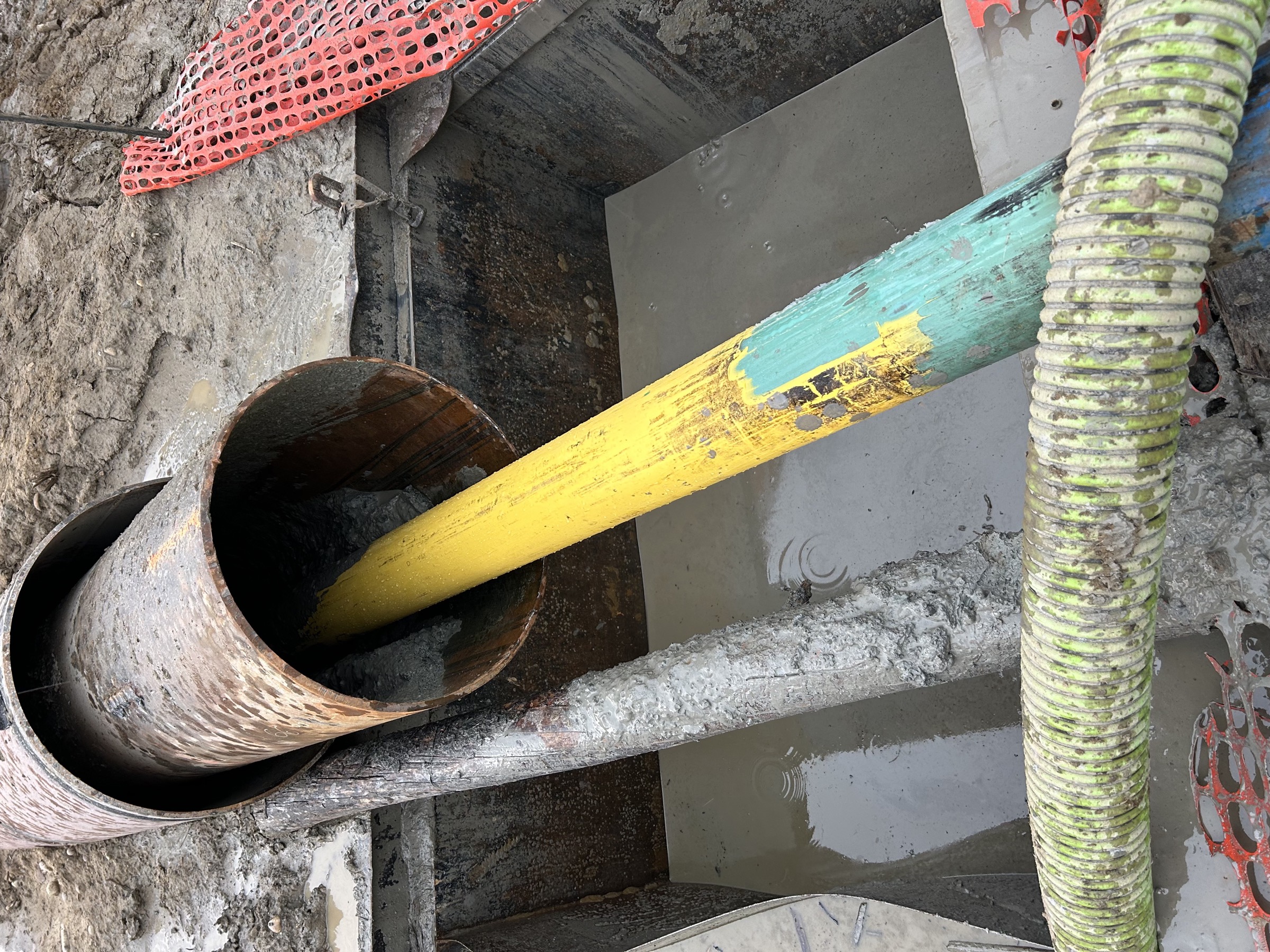
This is what an as-built is describing.
Product pipe arriving at the exit through steel casing, on a line somebody chose, at a depth somebody recorded, holding a separation from everything else in the corridor.
In ten years the only evidence any of that was done properly will be the bore log and the calibration record. They cost nothing to produce and they are the first thing asked for.
Anti-collision in a congested corridor
Where a new line is being installed alongside live ones, knowing the path is not enough — you have to know the clearance continuously. The pullback trajectory is overlaid on the pilot as-built in real time, with a radial tolerance beyond which the pull stops. Separation is computed, not asserted: half the final hole diameter plus a fixed clearance, with trenchless prohibited inside five metres of an existing facility unless the work is escalated to a critical ground-disturbance procedure.