
Footprint
The engineering argument for trenchless is risk. The commercial argument is usually the ground you never have to clear, grub, trench, backfill, reinstate and then be liable for.
The width
The wider corridor is needed only at deflections, tie-in points and the drill set-ups — typically fifteen metres there, and more at a segment tie point. Everywhere else the ground carries a narrow working width and is otherwise untouched: no trench, no spoil windrow, no topsoil stripping, no subsoil mixing.
What that does to a permit
On a recent northeast British Columbia system with an approved disturbance footprint of roughly 59 hectares, designing the line as a trenchless mainline planned to return about 44 of those hectares unused — close to three-quarters of the permitted disturbance. Utilisation varied by disposition; on two legs the plan was to disturb none of it at all.
Those are the figures from that project's execution design. They are specific to that alignment and that ground, and we would not quote them as a general expectation for yours.
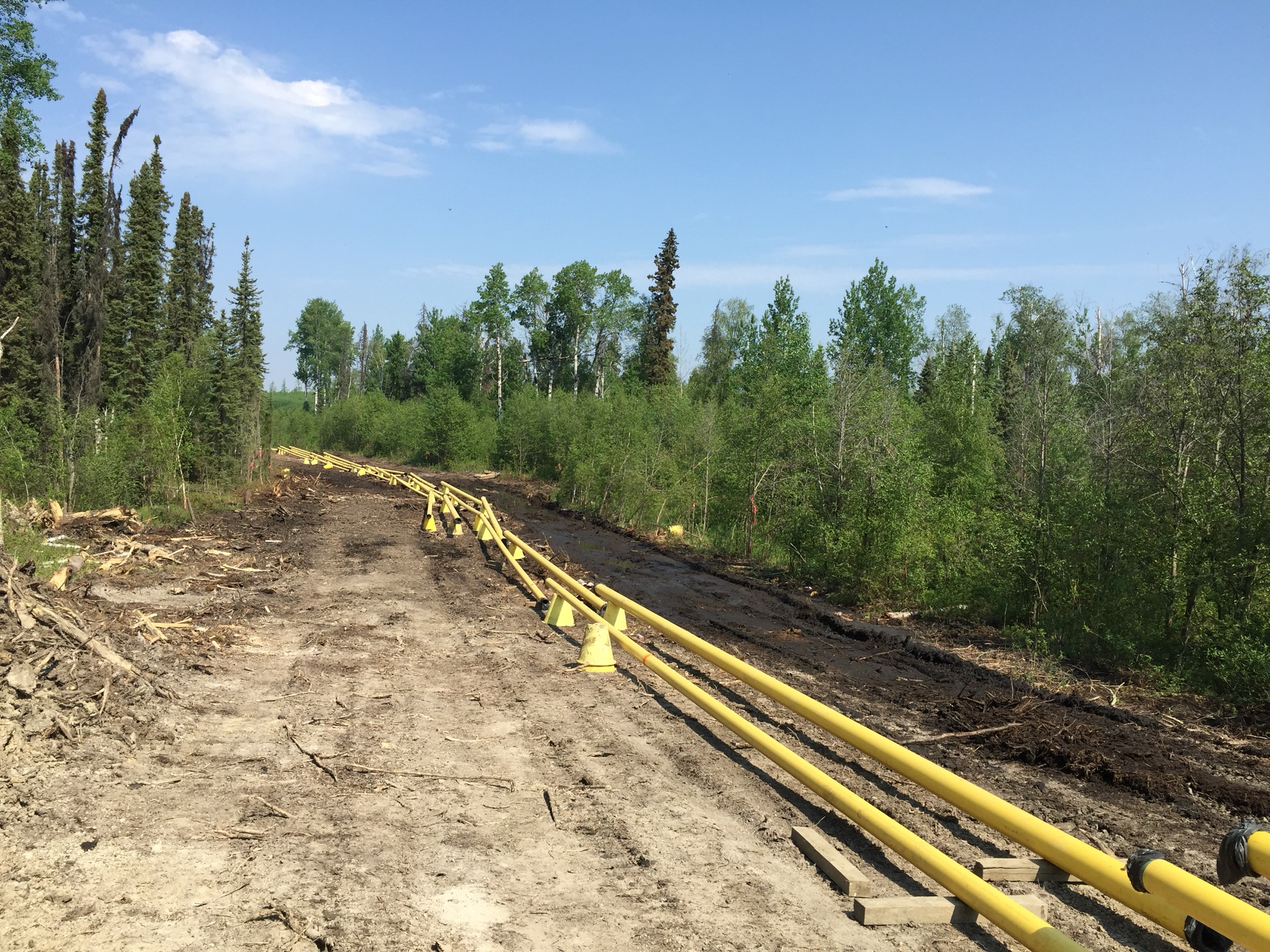
Three lines, one corridor, and the trees still standing on both sides of it.
A conventional right of way for this would be twenty-five to thirty metres of cleared, grubbed, trenched and reinstated ground. Everything outside the working width here was never opened.
That is the whole environmental argument, and it is also a cost argument: ground never disturbed is ground never reclaimed, never monitored, and never argued about at end of life.
Why it matters beyond the environmental report
The permit
On ground carrying riparian reserve, wildlife tree patches, old growth or archaeological sites, a narrow corridor is frequently the difference between a permit with conditions and no permit at all.
Reclamation liability
Ground never disturbed is ground never reclaimed, never monitored and never argued about at the end of life. This is a long-dated cost that rarely appears in the construction comparison.
Landowners and occupants
A five-metre corridor across a working field or a trapline is a different conversation from a thirty-metre one, and the conversation is often the schedule risk.
Timing windows
Less disturbance can mean fewer triggered constraints and a wider window, which on a winter programme can be the whole project.
Consultation
Reduced surface disturbance is a concrete, measurable commitment, and measurable commitments are what hold up in consultation.
Emissions
Less clearing, less earthmoving and less reinstatement is less fuel. It is real, it is modest, and we would rather state it plainly than dress it up.
Footprint reduction figures in this industry are quoted against whatever baseline flatters them, and the same method gets described as a 50 per cent saving or a 90 per cent one depending on the brochure. The honest version is a comparison of your alignment's trenchless working width against the conventional right of way it would otherwise need, computed on the actual disposition. We will do that arithmetic for your project and show the working.